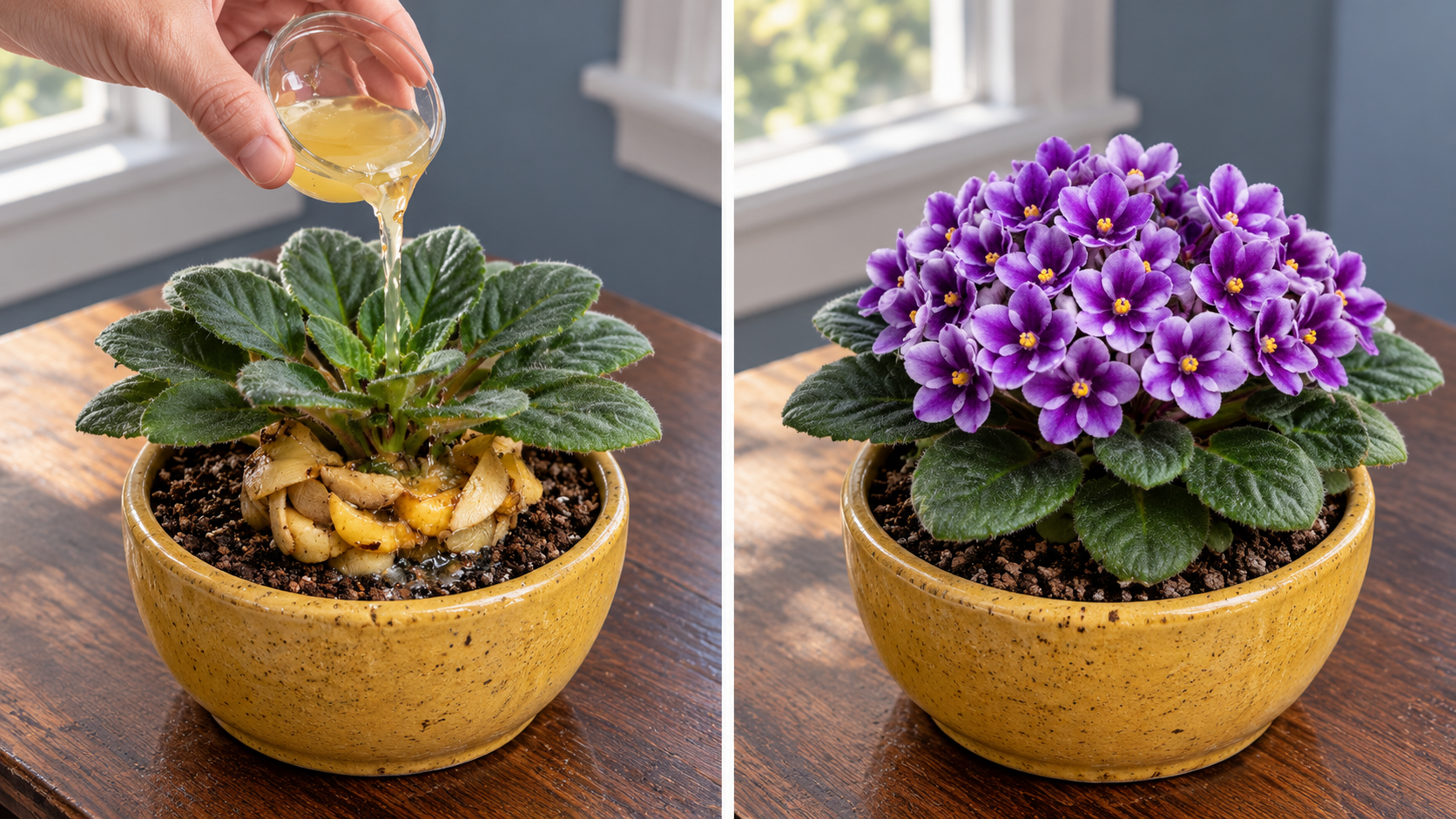
Just a spoonful! Discover the steps to help your violet get ready to bloom again
An African violet can keep a healthy-looking rosette of leaves while producing few flowers. When that happens, a spoonful of a homemade mixture may sound like an easy way to restart blooming. The more useful question is what the plant is missing in its everyday conditions. Light, root health, watering, and a suitable pot all influence whether it can support new buds.
This guide concerns the familiar indoor African violet, often sold under the name Saintpaulia and now classified within Streptocarpus. It is not a guide to outdoor garden violets. Begin with the plant you actually have, make a few observations, and change the clearest problem first. A measured approach makes the next stage of growth easier to understand.
Check the rosette before adding anything
Look at the center of the plant and the condition of its leaves. New leaves should be developing without a soft, collapsing center. Older outside leaves may decline over time, but widespread deterioration calls for closer inspection. Take a photograph of the whole plant so you can compare the arrangement and condition later. A single fading flower is not a complete diagnosis.
Note when the violet last bloomed and whether it has recently moved. A plant bought in flower may need time to adjust to a different window and watering routine. Avoid removing many healthy leaves simply to make room for imagined buds. Those leaves support the plant. Remove clearly spent flowers and damaged material carefully with clean tools, keeping the growing center intact.
Give the plant useful light
African violets need gentle, indirect light to grow and flower well. A location that looks bright across the room may receive little light at leaf level. Look at the actual window, any overhang, and the curtains between the plant and the sky. Avoid making a sudden change from a dim shelf to strong midday sun through glass.
Move gradually when a brighter position is needed, and check the leaves for pale or dry areas on the exposed side. Keep them away from cold window glass. If you use a plant light, follow its instructions for distance and duration rather than placing an unfamiliar lamp very close to the rosette. A consistent daily routine is easier to assess than changing the position every morning.
Water according to the potting mix
Use the moisture in the mix and the weight of the pot to guide watering. The goal is an evenly supported root environment without prolonged saturation. A dry surface alone does not show the condition at the center of the pot. Likewise, one damp spot near the rim does not describe the entire root ball. Learn how the same pot feels before and after watering.
Use water near room temperature and direct it carefully toward the potting mix. Avoid leaving water trapped in the crown. If watering from below is appropriate for your setup, allow the mix to take up what it needs and then remove the pot from standing water. Do not leave it indefinitely in a full saucer. Drainage still matters even when the watering method looks tidy.
After watering, inspect the decorative container or saucer. Empty excess water and make sure the plant sits securely. A regular weekly reminder can be helpful, but it should prompt a check rather than an automatic dose. Indoor heating, brighter light, and changes in pot size may alter how quickly the mix dries. The correct routine is the one that matches those conditions.
Understand what a spoonful means
A spoon measures volume, not suitability. A spoonful of concentrated fertilizer is very different from the same amount of a solution already diluted for use. Read the label and use the recommended measuring method. Do not borrow a dose from a different product simply because both packages mention flowering plants. Their concentrations may be different.
Coffee, sugar water, and kitchen leftovers do not provide a controlled feeding program. They can also change the surface of the potting mix and make its condition harder to judge. If your violet needs nutrients, use a suitable product as directed. If its roots are unhealthy or its light is inadequate, adding nutrients alone will not correct the cause.
Feed when the plant can use it
Check whether a recently purchased potting mix already contains fertilizer. Keep a simple record of feeding so two people do not unintentionally treat the same plant close together. During healthy active growth, appropriate feeding can support development. More frequent or stronger applications are not a shortcut to a guaranteed bloom date.
Do not respond to every yellowing outer leaf with another dose. Consider the whole plant and the recent care history. If the rosette is weakening, first investigate water, light, and the root environment. A cautious, identifiable adjustment provides more information than adding several products at the same time. Keep all products in their original labeled containers.
Choose a pot that fits the roots
A very large container is not necessarily a generous improvement. Extra mix around a small root system may stay wet longer than expected. Choose a pot and a suitable African violet mix that allow moisture and air to be managed together. Drainage openings must remain functional. Decorative stones at the bottom of a closed container do not create an outlet.
Repot for a practical reason, such as deteriorated mix, an unsuitable container, or a root environment that no longer works well. A flowerless week is not a reason to disturb a healthy plant. When repotting is needed, handle the leaves and roots gently and protect the growing center. Do not bury the crown deeply in an attempt to make the plant look more compact.
Clean fuzzy leaves gently
African violet leaves have a different surface from the smooth leaves of many tropical houseplants. Remove ordinary dust gently with a suitable soft, dry brush. Support the leaf and avoid pulling at its stem. Do not polish the foliage with oil, furniture products, or a mixture intended to make other leaves shine. Appearance alone is not a measure of plant health.
While cleaning, inspect the underside of leaves and the spaces near the center. If you notice pests, sticky deposits, or unusual marks, identify the problem before choosing a treatment. Keep the plant apart from others when a transferable pest is suspected. Follow a product’s suitability instructions rather than spraying several remedies in succession and hoping one will work.
Keep the surroundings stable
Avoid positioning the violet in a cold draft or directly beside a source of hot, dry air. Check what happens when a nearby door opens or the heating starts. The conditions at the shelf may be different from those measured in the center of the room. A stable location can make watering and growth easier to interpret.
Humidity and wet leaves are not the same thing. Constantly spraying the crown does not provide a controlled solution to dry indoor air. If a humidifier is used, maintain it properly and avoid creating persistent condensation around the plant. Allow gentle air movement without a harsh draft. The aim is a comfortable growing environment, not a permanently wet rosette.
Follow new growth instead of expecting an instant result
Photograph the plant from the same angle occasionally and compare new leaves and buds. Old damaged areas may never look perfect again, so use fresh growth and the absence of further decline as important signs. A plant can be making progress before it produces the flowers you are waiting for.
Avoid lifting it from the pot repeatedly just to inspect the roots. If the plant is stable, regular external checks are less disruptive. Rapid softening, collapse at the center, or an unpleasant smell deserves prompt investigation. If you cannot distinguish healthy tissue from a serious problem, consult an experienced grower and provide photographs and a description of the mix.
Frequently asked questions
Can a violet bloom again without a homemade supplement? Yes, a suitable environment and appropriate ordinary care are the foundation. There is no need to invent a new mixture merely because an online title mentions a spoon. What matters is the condition of the plant and the actual product, if any, being used.
Should you change everything at once? Usually it is easier to identify the main weakness and adjust it first. That does not mean ignoring a clear emergency such as a collapsing crown. It means avoiding unnecessary changes to a stable plant while you assess one relevant improvement.
What should you do today? Check the moisture, empty any water left in the saucer, and look at the light reaching the rosette. Record one useful observation and choose one practical next step. That modest routine is easier to repeat and more informative than an unmeasured dose added every week.